
The AI trade changed materially over the last month. Investors moved from rewarding capital expenditures to questioning the capital required to fund the AI buildout. Cloud revenue and contracted backlogs continued to grow while shortages in GPUs, memory, power, and permitted data center capacity restricted near-term supply. J.P. Morgan Global Research estimates that global AI capital expenditures will approach $900 billion in 2026 and total approximately $5.5 trillion through 2030.¹ These figures highlight not only the magnitude of the infrastructure cycle, but also the increasingly high returns required to justify the capital committed to it.
Neoclouds were also in focus this month as scrutiny around their capital structure increased. Neoclouds are specialized cloud computing companies built primarily to provide GPU compute for AI workloads. There has yet to be any bankruptcies or defaults for the neoclouds, but we did see a massive repricing of credit and equity risk across the board. The primary reasoning was investors increasingly bearish take on neocloud’s ability to service debt before their GPUs became less competitive. In October, shares of CoreWeave, Nebius, and IREN declined by -37%, -35%, and -41% respectively. CoreWeave was the focal point because its debt began trading at distressed levels. Unsecured notes that had been issued at a yield of approximately 9.6% fell below 80 cents on the dollar and began yielding around 15%. Those levels implied that lenders were demanding substantially more compensation for the risk of default or restructuring.
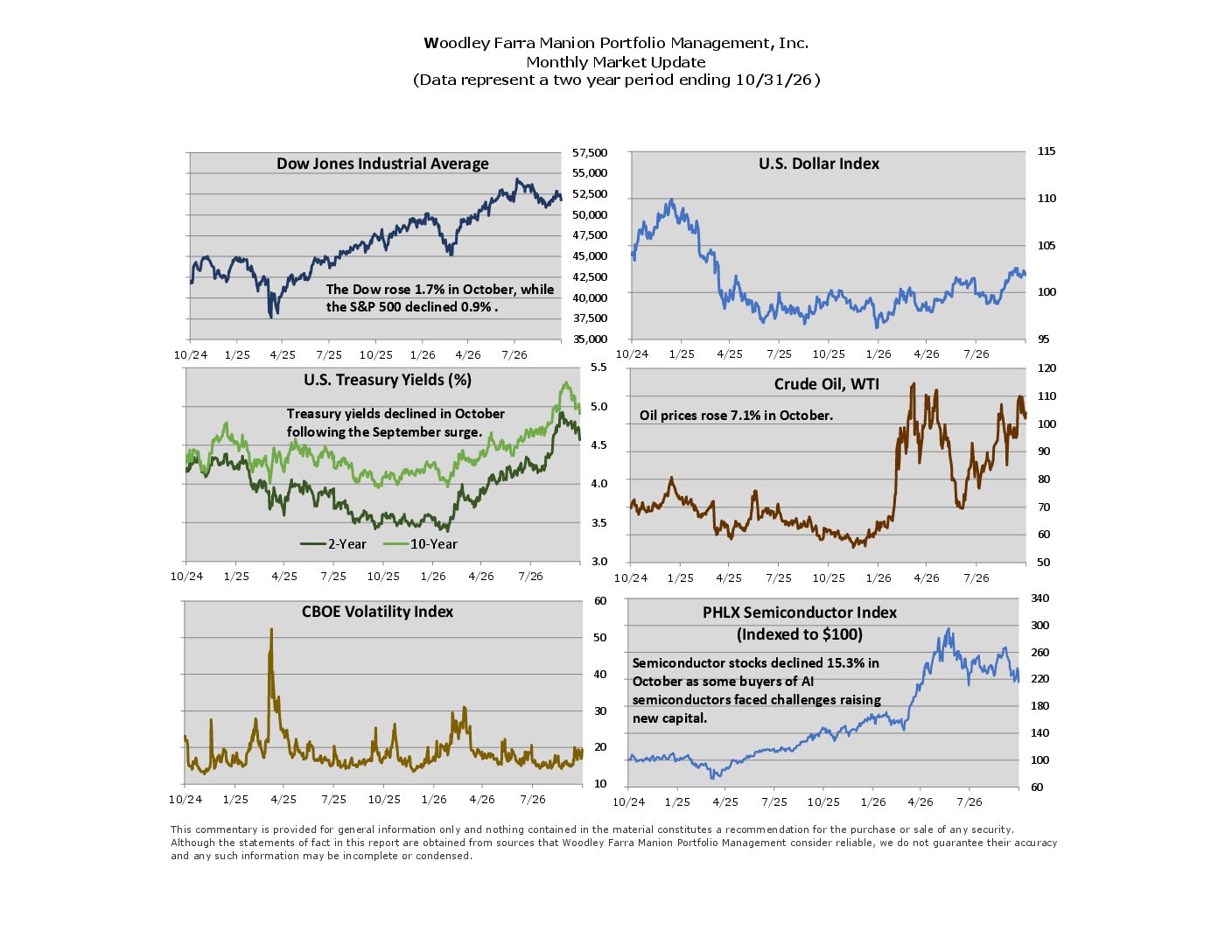
Higher rates dampen the neocloud model as well. September CPI came in at 3.7% YoY pushing treasury yields higher as investors assigned a greater probability to additional federal reserve rate hikes. This is especially damaging for neocloud because much of their expansion is financed with floating rate or high coupon debt. Gartner published a note on October 14th, 2026, that was very bearish on the economics of the AI infrastructure buildout. Their argument was that AI infrastructure spending is enormous, and that spending will require even more sales to justify. The nail in the coffin was a comment about neoclouds and that more than 80% of neocloud providers could cease independent operations by 2030 due to cost pressure and inadequate differentiation2. In addition, on October 25th Musk said SpaceX had secured $40B of debt for GPU purchases because it carried investment grade credit and generated revenue from Starlink/rocket launches. He also stated that the debt markets are going to be largely closed off to firms with just AI data center exposed revenue and ultimately predicted significant neocloud consolidation.
Lastly, we wanted to touch on DDTLs which are delayed-draw term loans that are used by neoclouds. These facilities allow a company to borrow in stages as GPUs are delivered, and customer capacity becomes operational. The loan is often secured by GPUs and by payments under specific customer contract. In March, CoreWeave completed an $8.5B investment grade DDTL backed by AI infrastructure and an associated customer contract. It’s a floating rate tranche priced at SOFR (a short-term US benchmark rate) + 2.25% while the fixed rate tranche priced near 5.9%. Currently we are seeing floating rates at around SOFR + 5.5%! If demand remains strong, the GPUs can be recontracted at attractive prices. If newer chips offer much better performance per dollar, the older fleet may need to be leased at lower rates. The borrower could then hold depreciating collateral that earns less revenue while the original debt remains outstanding.
¹ Source: J.P. Morgan Global Research, “What unprecedented AI capex means for markets and investors,” October 19, 2026.
2 Source: Gartner “Gartner Says Over $3.5 Trillion of AI Infrastructure Spending Could Be Exposed to Impairment by the End of 2030”, October 14,2026