

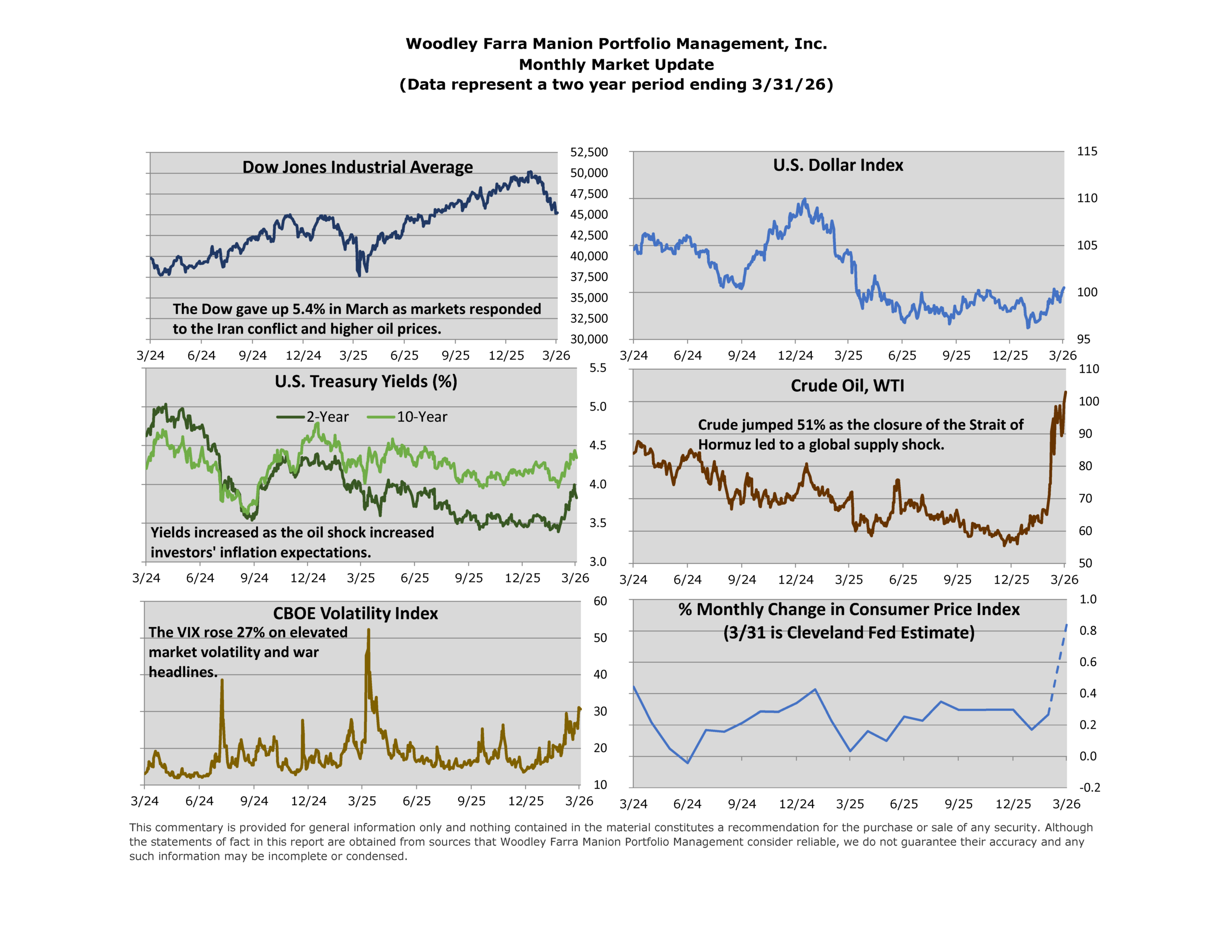
Stocks and bonds declined in March as conflict in the Middle East drove up prices for a broad set of commodities, from fertilizers and plastics to natural gas and oil. Pre-war, the Strait of Hormuz, handled roughly 20% of global crude oil and 20% of the world’s liquified natural gas (LNG). While global oil stockpiles are currently high, prolonged closure risks a sustained surge in energy prices. Because these commodities are widely used across the global economy, their price increases are powerful drivers of inflation. Consequently, the Cleveland Fed estimates that consumer prices rose 0.84% in March alone, which would mark the largest one-month jump in the Consumer Price Index since June 2022.
This resurgence in inflation has abruptly reset market expectations for interest rates. At the start of the year, markets implied a 0.50% cut to the federal funds rate in 2026. Markets are now pricing in no rate cuts. Speaking in late March, Chair Jerome Powell said the Fed is likely to hold rates steady and look beyond the conflicts’ energy shock for now but warned it won’t be able to sit on the sidelines indefinitely. The prospect of higher interest rates led to a selloff in stocks with high valuations and aggressive growth expectations. During the first quarter, the S&P 500 Growth index declined 8%, while the more reasonably priced S&P 500 Value index was flat. The technology sector also faced pressure amid growing caution over massive artificial intelligence (AI) capital expenditures and concerns of AI-driven economic disruption, particularly for software-related stocks. The so-called “SaaSpocalypse” has led to a 24% decline in the S&P Software & Services Index year-to-date.
Looking ahead, geopolitics and technology disruption remain a sharp focus. Volatility is to be expected in stock markets: the average intra-year decline for the S&P 500 is -14.2% since 1980 though the market has ended 36 of those 42 years with positive returns. We remain committed to our disciplined strategy of investing in high-quality companies with the balance sheet strength and stability to weather market turbulence.
-Jared J. Ruxer, CFA, MS