

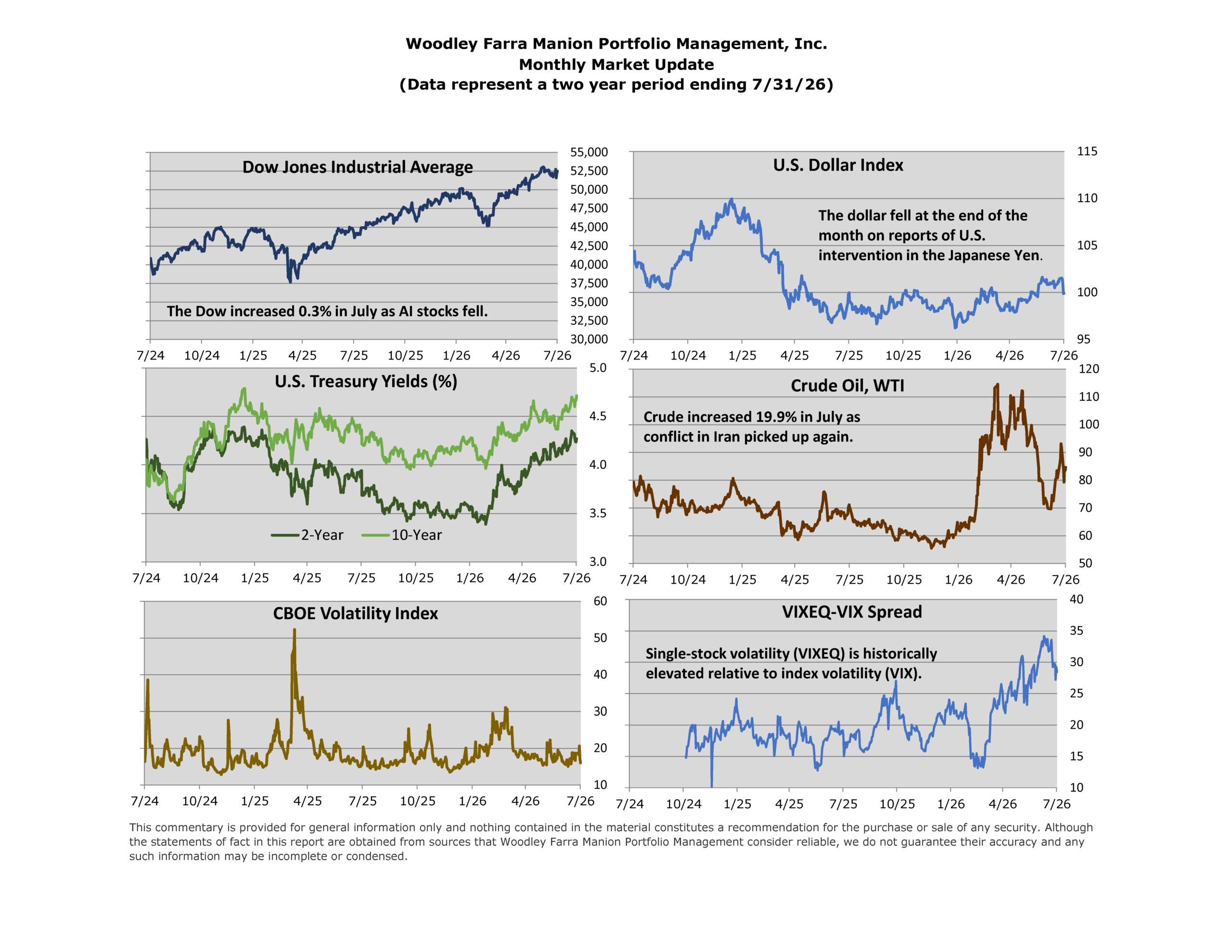
Markets spent the month balancing continued enthusiasm for AI-driven investment with shifting macro, geopolitical, and positioning risks. AI remained the dominant theme, supported by hyperscaler compute demand, cloud and data-center spending, and ongoing corporate commitment to infrastructure. Leadership, however, was uneven. Semiconductor and memory names were volatile, with sharp drawdowns before stabilizing late in July, while the broader rotation into financials, cyclicals, consumer groups, select healthcare, and software was inconsistent. Large-cap technology still supported the cap-weighted market, but elevated valuations left even strong earnings vulnerable when guidance, margins, capex plans, or AI monetization commentary fell short.
Earnings were broadly constructive for the month of July. Per FactSet data we’ve had 293/503 companies in the S&P500 report, of which 75.1% beat sales estimates by an average of 2.7% and 86.7% beat EPS estimates by an average of 19%. Key themes included continued AI investment, improving industrial demand, resilient consumer activity, healthy travel trends, and productivity gains. Investors remained selective, rewarding clearer evidence of durable growth and penalizing margin pressure, heavy spending needs, or uncertainty around the return on AI capex. Despite the focus on return on AI capex, Hyperscale’s FY2026 capex guidance increased. The five hyperscalers are expected to spend around ~$775B in 2026 which is a ~30% increase from guidance earlier in the year.
The economic backdrop remained supportive but mixed. Labor-market signals softened in places, including weaker payroll data and uneven private hiring, while jobless claims remained contained, and layoffs remained limited. Consumer spending and sentiment held up better than feared despite inflation and affordability pressures. Cooler core CPI and PPI prints helped ease rate pressure at points, but Fed officials emphasized that one month of better inflation data was not enough to declare victory. The Fed held policy steady as expected, while maintaining a hawkish bias focused on returning inflation to target.
Geopolitical volatility, particularly around Iran and key energy chokepoints, pushed oil and rates higher at times during the month. Risk sentiment improved late in the period as kinetic hostilities appeared to pause, helping markets recover some ground. Overall, July reflected a market still anchored by AI optimism and resilient growth, but increasingly sensitive to valuation, policy, and execution risks.
– Nicholas Thomas