

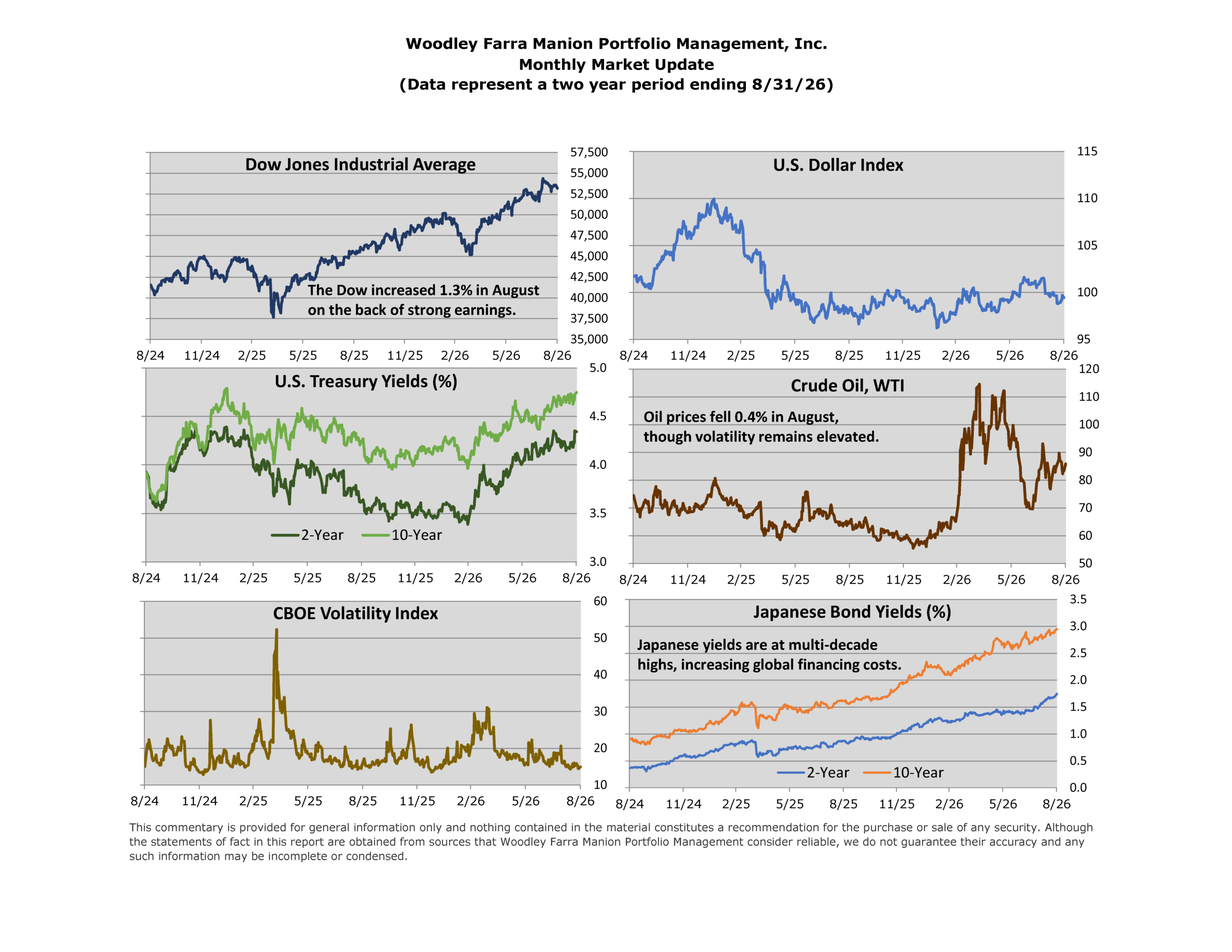
Stocks increased in August with the S&P 500 finishing the month up 2.6% and the Dow Jones Industrial Average closing the month up 1.3%. In a twist from the ongoing AI narrative, software stocks were a driving factor, with the iShares Expanded Tech-Software Sector ETF increasing 16.3% in August. For comparison, the iShares Semiconductor ETF, a barometer of the AI trade, only rose 1.2% in August. The sizeable gap between the previously inversely correlated cohorts can be attributed to strong earnings from software companies that pushed back against the AI replacement theme. Additionally, increasing concerns over off-balance sheet liabilities, growth sustainability, and AI model competition continue to weigh on AI-related stocks.
As stocks continue to chug along, debt markets are having a much tougher time. In the U.S., the 30-year Treasury yield reached a 19-year high in August driven by persistent inflation above the Federal Reserve’s target of 2%, concerns over the increasing government debt load, and reverse crowding out from AI-related debt issuance. The first two reasons are not exactly new and have been concerns for bond investors for years now. The third is a new development resulting from unprecedented debt and equity issuance tied to the AI infrastructure buildout. As AI-related companies issue hundreds of billions of dollars in debt, it forces yields up across the entire debt market. As a result, new U.S. government issuances are forced to offer increasingly higher rates to stay competitive.
However, it is not just U.S. yields that are rising. Japan, long known for having some of the lowest relative interest rates in the world, has seen its 10-year yield hit a 30-year high. This is a big problem for a few reasons. First and foremost, high Japanese yields have impaired the popular carry trade of borrowing in Yen to invest in other currencies with higher yields. Secondly, higher yields have dampened the growth outlook within Japan, which is the fourth largest economy in the world as measured by nominal GDP. This has a secondary effect of weakness in the Japanese Yen. As a result, Japanese policymakers have started intervening by selling other nations’ sovereign debt and buying the Yen with the intent of increasing the currency’s value. In a rare move, the U.S. joined Japan in this effort with the U.S. Treasury also buying the Yen. This action kept Japan from liquidating its vast U.S. Treasury holdings, which would have put additional stress on U.S. yields.
As always, we are continuing to monitor global interest rates and their impacts on U.S. markets.
-Levi Gates